- CRE Daily
- Posts
- Distressed Office Sales Top $5B as Discounts Reset the Market
Distressed Office Sales Top $5B as Discounts Reset the Market
After years of bid-ask paralysis, distressed office trades are moving again, and the discounts are doing the ugly work of establishing a new floor.

Jordan B.
April 13, 2026
Together with

Good morning. Distressed office buildings are finally trading again — at prices that would have been unthinkable five years ago — and the deep discounts clearing the market today are quietly laying the groundwork for what comes next.
Today’s issue is sponsored by Terrakotta—AI-powered prospecting with direct contact info for 20M+ CRE tenant decision-makers.

🎙️ This week on No Cap—Jack and Alex sit down with Chris Hentemann (Founder & CIO, 400 Capital) to break down how structured credit works, where capital is flowing, and why the biggest opportunities often emerge from market dislocations.
CRE Trivia 🧠
What was the first office building in the United States to be converted into residential apartments?
(Answer at the bottom of the newsletter)
Market Snapshot
|
| ||||
|
|
Finding a Floor
Distressed Office Sales Top $5B as Discounts Reset the Market

After years of bid-ask paralysis, distressed office trades are moving again, and the discounts are doing the ugly work of establishing a new floor.
The volume is picking up: More than 200 distressed office properties traded in 2025, up significantly from 2023, with foreclosure and bankruptcy-related transactions alone topping $5 billion. Early 2026 is already outpacing that momentum. Buildings that once commanded nine-figure valuations are changing hands at fractions of those levels — downtown Chicago towers trading under $30 per square foot, assets in Denver and Washington D.C. at prices that would have been unthinkable a decade ago.
New York is converting its way through the problem: Discounted acquisitions in Manhattan are fueling a growing office-to-residential pipeline. David Werner has built a repeat strategy around it, picking up older office buildings at steep discounts — his latest Hell's Kitchen deal closed at roughly a third of its 2018 price.
Case in point: Nathan Berman's Metro Loft and Idan Ofer's Quantum Pacific are in contract on 1 Whitehall Street for just over $100 million, planning a rental conversion after its foreclosure out of the Chetrit Organization. RXR's $500 million recapitalization of 55 Broad Street alongside Silverstein and Metro Loft signals that institutional capital is now comfortable stepping into stabilized post-conversion assets.
Not everyone has a conversion plan: Igal Namdar — fresh off his $280 million purchase of ESRT's 250 West 57th Street — represents a different buyer profile entirely: opportunistic investors targeting midtier buildings with enough income to justify a long-term hold at a dramatically lower basis. No conversion thesis required. Just a bet that today's pricing leaves enough room for upside regardless of use.
Chicago and LA are the deepest in the hole: Chicago is seeing some of the steepest discounts nationally, with sales driven by distress rather than vision — vacancy is still rising and conversions haven't been enough to offset shrinking demand. Los Angeles is working through a wave of defaults tied to legacy debt, pushing large assets into deeply discounted trades with no clear resolution timeline.
South Florida is sitting it out: Deal flow in the region has slowed as buyers wait for better visibility on rates and the broader economy. The market remains attractive in theory — but selective in practice.
➥ THE TAKEAWAY
Why it matters: Distressed office trades are doing the market's dirty work — establishing price discovery where there wasn't any, unlocking deals that were frozen by bid-ask gaps, and giving buyers with different playbooks a reason to engage. The reset isn't pretty, but it's necessary.
TOGETHER WITH TERRAKOTTA.AI
26-Year Old Broker Wins $10,000 for Prospecting

Meet Robbie Swindell, winner of the 2026 Terrakotta Madness cold calling tournament.
Robbie beat out 64 other brokers, maximizing talk time to win the $10,000 cash prize. Not just by outworking the field, but by out-informing them.
Robbie didn’t win on volume. He outscored opponents by turning Terrakotta’s rich data into accurate prospect lists and clean insights that investors and developers want to know.
Verified contact info. Portfolio and property details. Loan insights. Relevant comps. All in one place, orchestrated by AI right in front of him while he called.
In a recent interview, Robbie shared the 7 keys to becoming the #1 caller in the country.
We paired them with internal Terrakotta analytics to uncover what actually drives better conversations and more business.
Click the button below to see them for yourself and learn more about Terrakotta.
*This is a paid advertisement. Please see the full disclosure at the bottom of the newsletter.
✍️ Editor’s Picks
Inflation Nation: U.S. inflation rose to 3.3% in March (vs. 2.4% prior), with gas prices jumping 21% month-over-month and construction costs already up 12.6% annualized, signaling renewed pressure on CRE.
Talent gap: Building a CRE back office shouldn't cost a fortune. Relay Human Cloud places dedicated Yardi specialists, accountants, and APMs — globally sourced, Dallas-managed, 75% less than U.S. hiring. (sponsored)
Fee squeeze: Surging HOA and condo fees—up roughly 26% since 2019—are compounding housing costs and increasingly pricing buyers and owners out of the market as rising insurance, maintenance, and special assessments strain affordability.
Commission dispute: Cushman & Wakefield is suing Sotheby’s for a $10.2M commission tied to the $510M sale of its NYC HQ (~200K SF lease involved), alleging it was cut out of the deal.
Global slowdown: Global REIT returns slowed to +1.3% in Q1, with North America leading at +4.7% while office lagged at -11.4% YTD amid rising volatility.
Built for scale: Turn Excel models into institutional-grade OMs and BOVs in minutes—dramatically cutting production timelines for high-volume deal teams. (sponsored)
Safe haven: Government-leased real estate is emerging as a defensive play, with investors targeting stable cash flows amid 3–4% inflation expectations and elevated rate uncertainty.
🏘️ MULTIFAMILY
CA slowdown: Orange County rents reached $2,736/month (+1.1% YoY), as growth moderates sharply from 12.5% in 2021–22 to ~3.4% recently amid weaker demand and rising supply.
Affordable funding: New York is deploying $152M in financing for two NYC projects, including a 193-unit Brooklyn development with 116 housing units, as part of a broader $350M statewide housing initiative.
Antitrust settlement: Camden Property Trust agreed to pay $53M to settle RealPage rent-fixing claims, joining landlords that have collectively paid $140M+ to resolve the nationwide lawsuit.
🏭 Industrial
Cap reset: Industrial cap rates have stabilized around 6.44%, ~120 bps above 2022 lows, as higher borrowing costs reset pricing and limit further compression.
The cost of war: Oil prices near $90/barrel have pushed inflation to 3.3% and lifted the 10-year Treasury to ~4.3% (+30 bps), raising capital costs while boosting demand for warehouse space.
Mega project: Covington secured approvals for a 9.4M SF industrial project on 510 acres in Palmdale, with total buildout exceeding $1.2B, marking one of LA County’s largest-ever industrial entitlements.
🏬 RETAIL
QSR demand: SRS brokered $78.5M across 14 Chick-fil-A properties in Q1, with assets trading at ~4.29% cap rates and 13.8-year lease terms.
Mall momentum: Open-air malls are leading LA’s retail comeback, with visits up 5.1% YoY and major deals like the $530M Victoria Gardens sale driving transaction volume higher.
Retail portfolio: Medipower acquired a 558K SF, 7-property retail portfolio for $115M (~$206/SF) that was 99.6% leased, highlighting strong demand for grocery-anchored centers.
Going dark: Apple is closing 3 mall locations in June as declining tenant bases and foot traffic signal ongoing challenges for struggling retail centers.
🏢 OFFICE
Midtown refi: Rithm Capital secured a $282.5M loan from JPMorgan to refinance its stake in the 825K SF, 34-story 1325 Avenue of the Americas, continuing activity across Paramount’s former office portfolio.
Shrinking supply: Chicago suburban office inventory is tightening, with 6.3M SF removed since 2020 and no new construction, helping stabilize vacancy at 26.8%.
AI pressure: Office vacancy could rise to 21.5% by 2030 (+170 bps) as AI dampens demand, following a record 20.6% vacancy peak in 2025.
🏨 HOSPITALITY
Hotel momentum: U.S. hotels posted a record Q1 with +5.9M rooms sold YoY and RevPAR up 3.6%, though demand dipped 4.6% during Easter week due to seasonal slowdown.
Distress: Bay Area hotels face rising defaults as rates hit ~6.5% and RevPAR rebounds to $155 (still ~24% below 2019), triggering a new wave of forced sales.
A MESSAGE FROM ZIFF PROPERTIES
Access Institutional‑Quality Retail Investments With True Alignment
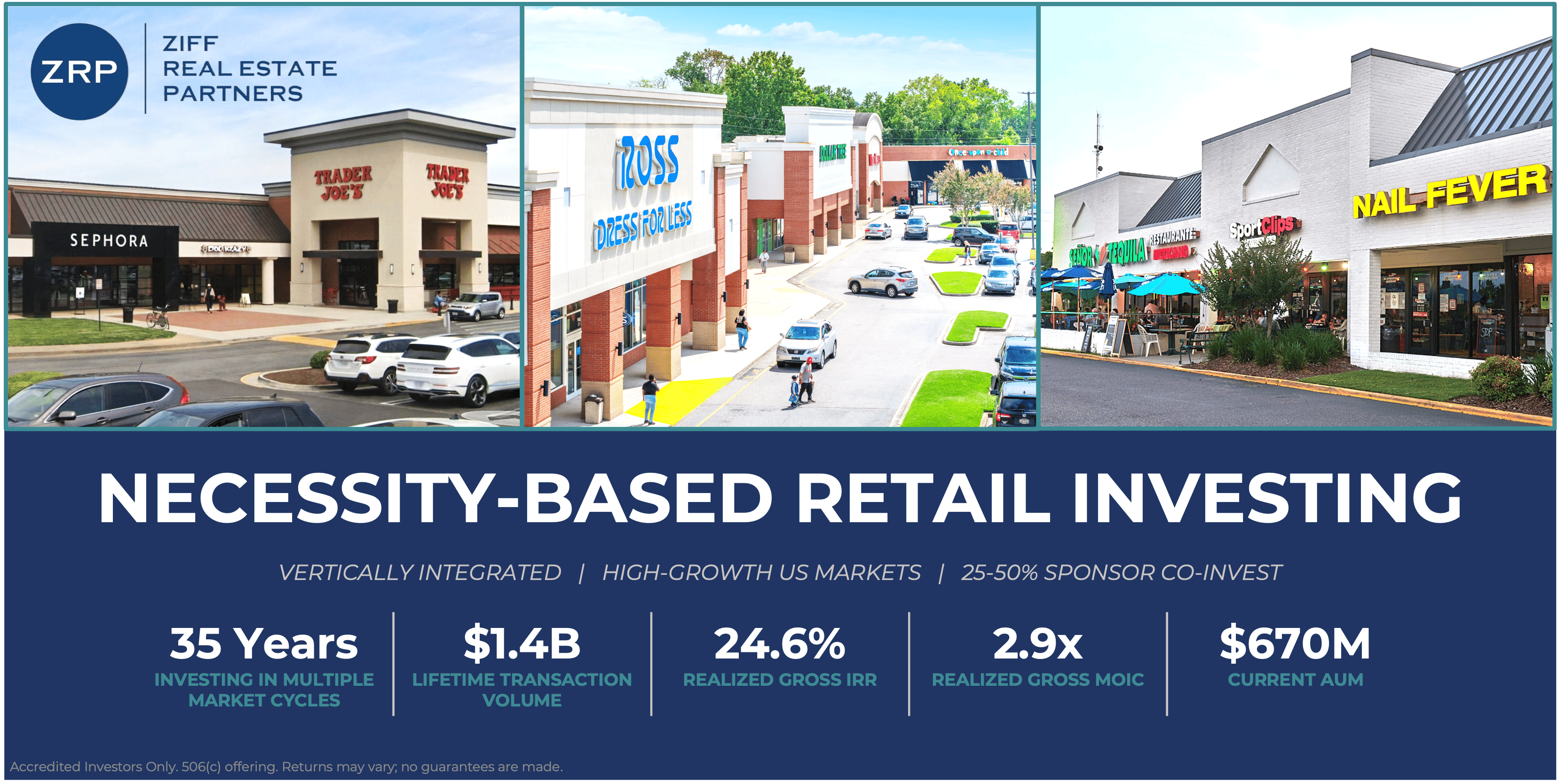
Vacancy is near historic lows. New supply is constrained. Necessity-based tenants are driving consistent demand.
That’s why capital is flowing back into retail.
Ziff Real Estate Partners has spent 35 years acquiring grocery-anchored and service-driven centers, creating value through active leasing and repositioning.
While typical GP commitments range from 5% to 10%, ZRP often invests 25% to 50% of the total equity in each transaction.
The result is a structure where partners succeed together.
Historically, these opportunities were locked up by institutions.
Now, access is opening to accredited investors.
*This is a paid advertisement. Please see the full disclosure at the bottom of the newsletter.
📈 CHART OF THE DAY

CRE Trivia (Answer)🧠
The Willard Hotel in Washington, D.C. is often cited as one of the earliest large-scale conversions, but the more historically documented answer is the Navarro Apartments in New York City — originally built as a hotel in the 1880s and converted to residential use shortly after. The practice of adaptive reuse has come full circle today, with New York leading the nation in office-to-apartment conversions with nearly 90,000 units in the pipeline as of 2026.
More from CRE Daily
📬 Newsletters: Stay ahead of the market with local insights from CRE Daily Texas and CRE Daily New York.
🎙️Podcast: No Cap by CRE Daily delivers an unfiltered look at the biggest trends—and the money game behind them.
🗓️ CRE Events Calendar: The largest searchable calendar of commercial real estate events—filter by city or sector.
📊 Market Reports: A centralized hub for brokerage research and market intelligence, all in one place.
📈 Fear & Greed Index: A fully interactive sentiment tracker on the pulse of CRE built in partnership with John Burns Research & Consulting.

You currently have 0 referrals, only 1 away from receiving Multifamily Stress Test Model.
What did you think of today's newsletter? |
Reply