- CRE Daily
- Posts
- One Decade of Underbuilding. Ten Million Missing Homes.
One Decade of Underbuilding. Ten Million Missing Homes.
The White House puts the housing shortage at 10 million units. That's nearly 3x what Freddie Mac estimated.

Nina Dale
April 15, 2026
Together with

Good morning. For years, nobody could agree on how bad the housing shortage really was. Turns out, it was worse than all of them.
Today’s issue is sponsored by Arcstone Multifamily Risk Advisors—insurance quotes are dropping. Are you capturing the savings?
🎙️ This week on No Cap: Chris Hentemann (Founder & CIO, 400 Capital) breaks down how structured credit works, where capital is flowing, and why the biggest opportunities often emerge from market dislocations.
CRE Trivia 🧠
In what year did U.S. single-family housing starts peak before the post-2008 collapse that the White House report blames for today's supply gap?
(Answer at the bottom of the newsletter)
Market Snapshot
|
| ||||
|
|
Housing Shortage
White House Says the U.S. Is Short 10 Million Homes — and That's the Conservative Estimate
The administration's own economists just put a number on the housing crisis that blows past every prior estimate — and it's reshaping the policy debate heading into midterms.
The math is brutal: The Council of Economic Advisers, in its latest Economic Report of the President, officially pegged the single-family housing deficit at 10M units — what would exist today if homebuilding hadn't fallen off a cliff after 2008 and never fully recovered. That number tops virtually every prior estimate from both government sources and private analysts, most of which landed in the 3–7 million range across all housing types.
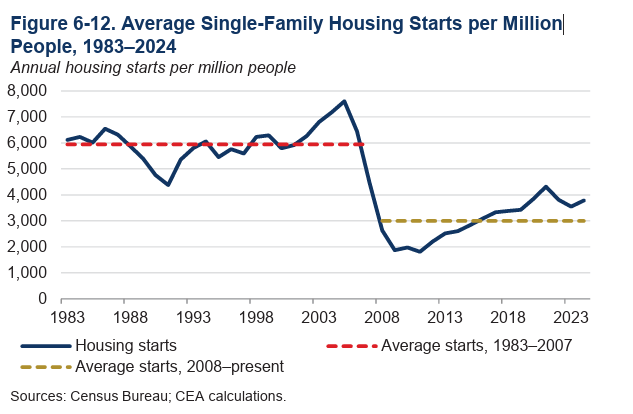
What it means for Multifamily: Every missing single-family home is a household that can't buy — and most of them are renting instead. The ownership pathway is functionally closed for a significant chunk of would-be buyers between elevated mortgage rates, thin for-sale inventory, and prices that never corrected. That trapped-renter cohort is the demand floor multifamily operators have been quietly riding for three years.
Bullish on BTR: Build-to-rent operators sit directly at the intersection of this shortage. With single-family homeownership out of reach for a generation of would-be buyers, BTR communities are absorbing demand that the for-sale market simply can't serve. A White House report quantifying that gap at 10 million units is essentially a 10-million-unit argument for why BTR's runway is longer than most underwriting models assume.
Rates aren’t playing along: The White House directed Fannie and Freddie to buy $200 billion in mortgage bonds to push rates lower, a move that briefly worked before Middle East tensions sent them back up. The 30-year fixed now sits at 6.37%, per Freddie Mac, more than double where it was five years ago.
➥ THE TAKEAWAY
Supply math doesn’t lie: A 10-million-home single-family deficit means the renter pool stays deep, BTR demand stays durable, and the ownership escape valve stays largely shut. The policy response may eventually add supply pressure, but bridging a 10-million-unit gap takes decades. NOI assumptions built on strong occupancy have more structural support than the cycle alone would suggest.
TOGETHER WITH ARCSTONE INSURANCE ADVISORS
Protect Your Portfolio from the Risks That Hit Hardest

Wind, hail, hurricanes, snowstorms, fire. These threats can hit your properties and profits hard. Multifamily Risk Advisors keeps risk advisors active to catch trouble before it becomes a claim.
Coverage is cleaned of outdated limits and useless add-ons. Over 60 carriers provide options that actually protect your portfolio. From fire hazards to roof leaks and hurricanes, proactive mitigation turns risk into financial leverage.
Protect your assets, lock in savings, and keep cash flow steady.
*This is a paid advertisement. Please see the full disclosure at the bottom of the newsletter.
✍️ Editor’s Picks
Fundraising Automation Playbook:10 Plays to Prevent Stalled Commitments and Win More Investors in 2026. (sponsored)
IPO watch: Blackstone has filed for an IPO of its new data center REIT, aiming to capitalize on surging demand for digital infrastructure with stabilized assets in top-tier markets.
Buyouts on the rise: CRE M&A activity has rebounded sharply with $28B in Q1 deals as investors pivot to hard assets and discounted REITs amid market volatility.
Up to 50% reduction in insurance costs through captives: Used by institutional owners & 90% of Fortune 500 companies, now available to $100MM to $3BN Portfolios through Real Property Captive. (sponsored)
Distress driver: Rising office loan delinquencies and rate uncertainty are expected to fuel more CRE deals and restructurings, while data centers and select assets remain bright spots.
Senior bet: National Healthcare Properties is targeting up to $616M in an IPO to expand its senior housing portfolio and tap into favorable demographic trends.
Zoning standstill: D.C.’s zoning board has been unable to meet due to member vacancies, freezing development approvals, and delaying projects across the city.
🏘️ MULTIFAMILY
Move-out bonus: A Las Vegas landlord is offering renters up to $4,800 toward a home purchase to incentivize turnover and attract new tenants.
Muted momentum: The 2026 apartment market is improving on paper but remains sluggish in reality as supply overhang and concessions limit rent growth.
JV expansion: Eagle Real Estate and TriPost Capital launched a $1.5B joint venture to acquire and convert West Coast multifamily assets into affordable housing.
Retro revival: Cleveland’s adaptive reuse boom is turning historic buildings into apartments, fueling downtown population growth and attracting a diverse renter base.
🏭 Industrial
Chip investment: Texas A&M broke ground on a $226M semiconductor R&D facility aimed at boosting domestic chip production and workforce development.
Storage rebound: Self-storage is nearing a recovery as slowing development and steady demand draw investors back despite recent rent and occupancy declines.
Desert megaproject: A 9.4M SF industrial project in Palmdale has secured full approvals, positioning the High Desert as a growing logistics hub amid Inland Empire constraints.
Value harvest: Brookfield sold a South Florida warehouse portfolio for $78M, more than doubling its investment after boosting rents and occupancy.
🏬 RETAIL
Pump network: Costco is launching standalone, membership-only gas stations to capitalize on high fuel prices and drive customer traffic beyond its warehouse stores.
Anchor reset: Saks and Neiman Marcus store closures are creating redevelopment opportunities for top-tier malls while threatening weaker centers reliant on anchor traffic.
Neighborly love: Neighborhood retail centers are gaining leasing momentum as demand for food, beverage, and service tenants strengthens ahead of ICSC Las Vegas.
🏢 OFFICE
Pod play: WeWork is rolling out bookable office pods in high-traffic locations like airports and hotels to adapt to more flexible, on-the-go work patterns.
Power lunch: High-end dining is returning to major office towers as rising attendance helps revive the power lunch as a key workplace amenity.
Refi of the day: Blackstone secured a $154M refinancing for its MiamiCentral office towers as downtown vacancy remains elevated and demand shifts to cheaper submarkets.
🏨 HOSPITALITY
Pricing divide: Hotels are maintaining stronger occupancy while short-term rentals compete more aggressively on price, highlighting diverging revenue strategies across lodging models.
Scale play: Yotel is partnering with Hilton to expand its global reach, boost direct bookings, and accelerate growth through greater distribution.
A MESSAGE FROM ZIFF PROPERTIES
Invest with Aligned Sponsors Through Vertically-Integrated Platform
Most sponsors outsource. ZRP does not.
Ziff Real Estate Partners operates a fully-integrated platform — sourcing, leasing, property management, and asset management handled entirely by internal teams.
That means faster decisions, lower operating costs, and NOI growth that third-party managers simply can't deliver.
When you control every step in necessity-based retail investing — from acquisition to repositioning to disposition — value compounds at every turn. Occupancy gets optimized. Rents get marked to market. Deferred maintenance gets cured.
That operational intensity is why ZRP has compounded investor capital over 20% annually for 35 years.
Accredited investors can access these results.
*This is a paid advertisement. Please see the full disclosure at the bottom of the newsletter.
📈 CHART OF THE DAY
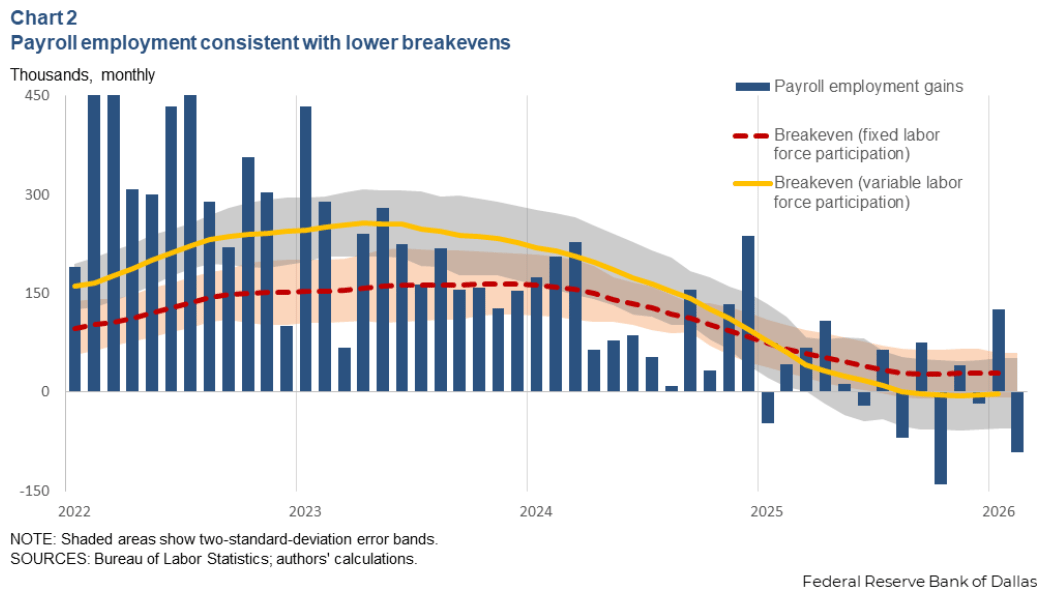
Payroll growth that appears weak by historical standards is still sufficient to keep unemployment stable because the break-even level of job creation has dropped sharply amid declining immigration and labor force participation.
CRE Trivia (Answer)🧠
2005 — single-family starts hit approximately 1.72M that year, a post-WWII record. By 2009, they had cratered to just 445,000, the lowest level since the Census Bureau began tracking the data in 1959.
More from CRE Daily
📬 Newsletters: Stay ahead of the market with local insights from CRE Daily Texas and CRE Daily New York.
🎙️Podcast: No Cap by CRE Daily delivers an unfiltered look at the biggest trends—and the money game behind them.
🗓️ CRE Events Calendar: The largest searchable calendar of commercial real estate events—filter by city or sector.
📊 Market Reports: A centralized hub for brokerage research and market intelligence, all in one place.
📈 Fear & Greed Index: A fully interactive sentiment tracker on the pulse of CRE built in partnership with John Burns Research & Consulting.

You currently have 0 referrals, only 1 away from receiving Multifamily Stress Test Model.
What did you think of today's newsletter? |
Reply