- CRE Daily
- Posts
- U.S. Cities Face a $1 Trillion Infrastructure Problem
U.S. Cities Face a $1 Trillion Infrastructure Problem
Older cities face growing infrastructure burdens as deferred maintenance costs top $1 trillion nationwide.

Nina Dale
May 07, 2026
In partnership with

Good morning. America’s infrastructure bill is getting harder to ignore. A new study estimates U.S. cities are carrying more than $1 trillion in deferred infrastructure wear and tear, exposing growing financial pressure on municipalities, investors, and long-term economic growth.
🎙️This Week on No Cap: Harbor Group International’s Richard Litton breaks down scaling to $21B, the shift from office to credit, and where he’s finding opportunity in a reset CRE market.
CRE Trivia 🧠
In 2007, Sam Zell sold Equity Office Properties to which private equity firm for approximately $39B, completing what was then the largest leveraged buyout in history?
(Answer at the bottom of the newsletter)
IN PARTNERSHIP WITH PACE LOAN GROUP
Development Financing, Your Way

A 114-unit multifamily development in Philadelphia received a $10.6 million C-PACE loan from PLG to blend down cost of capital and partner with a debt fund that was constrained by internal lending limits.
When traditional construction financing is too expensive, when you need capital to partner with alternative financing (EB-5 or USDA), or when your project is struggling to find sufficient, accretive debt, think of C-PACE financing.
*This is a paid advertisement. Please see the full disclosure at the bottom of the newsletter.
Market Snapshot
|
| ||||
|
|
Aging America
U.S. Cities Face a $1 Trillion Infrastructure Problem
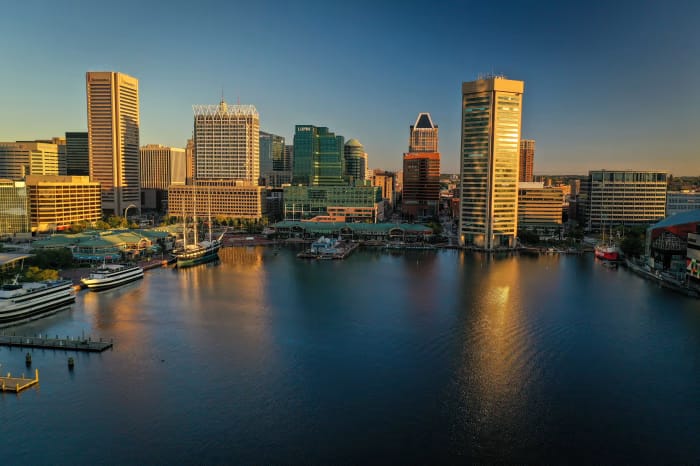
Baltimore is planning significant infrastructure updates. Jerry Jackson/Baltimore Sun/Tribune News Service via Getty Images
America’s aging roads, bridges and public systems are becoming a hidden financial liability for cities nationwide — and the bill is coming due.
Hidden burden: A new study by municipal finance researcher Richard Ciccarone estimates that U.S. cities are carrying roughly $1.03 trillion in deferred infrastructure wear and tear across roads, bridges, buildings, and utilities. Covering 2,000 municipalities, the report highlights major infrastructure obligations that largely remain off city balance sheets.
Why it matters: Unlike pensions, cities face no accounting penalty for delaying infrastructure repairs, often pushing maintenance behind debt payments and other budget priorities as systems continue aging.
Cities under pressure: Older cities like Philadelphia, Baltimore, and Milwaukee ranked among the most burdened due to aging infrastructure. Philadelphia is weighing $1.5 billion in city-funded upgrades over six years, while Baltimore continues a decade-long infrastructure overhaul.
Fast-growing Sun Belt markets fare better: Cities like Austin, Charlotte and Phoenix ranked well thanks to newer infrastructure and population growth, while Jacksonville benefited from local infrastructure taxes, federal aid and hurricane-related reinvestment.
A growing risk for investors: Ciccarone’s report compares infrastructure liabilities to the pension-accounting reforms of the 2010s, which forced cities to recognize long-term obligations and led to tax hikes, spending cuts and pressure on municipal bonds. Analysts say infrastructure could become the next major fiscal challenge for local governments.
What’s driving the estimate: The methodology estimates infrastructure wear based on an asset’s age, replacement cost and expected lifespan, aiming to quantify deferred deterioration cities will eventually need to address.
➥ THE TAKEAWAY
Infrastructure premium: For CRE investors and developers, aging infrastructure is becoming a bigger market risk. Cities with stronger tax bases and newer systems may be better positioned to support long-term growth, investment, and redevelopment activity.
A MESSAGE FROM BUILDOUT
Still losing deals to a messy tech stack?

The Buyer’s Guide to CRE Tech shows brokers how to spot gaps, cut admin time, and choose tools that drive listings and revenue. Audit your systems, eliminate inefficiencies, and build a smarter stack.
Download the free guide and start winning more deals today.
*This is a paid advertisement. Please see the full disclosure at the bottom of the newsletter.
✍️ Editor’s Picks
Underwrite deals in minutes: Eliminate hours of manual modeling — AI underwriting that helps you parse, analyze, and identify the most promising multifamily deals in record time. (sponsored)
Discount deals: US REIT M&A is accelerating into early 2026, with $16.8B across four deals as investors target undervalued public REITs trading at steep discounts to NAV.
Opportunity reboot: Peakline is targeting a $1.3B raise for its fourth opportunity zone fund to capitalize on OZ 2.0 tax incentives, with a dual urban-rural strategy aimed at unlocking over $3B in total investment.
AI advantage: AI is becoming the connective tissue of CRE brokerages, helping firms automate up to 37% of their tasks by unifying prospecting, CRM, marketing, and deal management into a single AI-powered workflow. (sponsored)
Selective defeasance: CMBS defeasance activity hit its lowest level in a decade in 2025, with just $5.2B completed as only top-performing assets drove transactions in an increasingly selective market.
Project pause: Meta has paused its 1.6M SF Willow Village project in Menlo Park due to weaker demand and shifting market conditions.
Fitch acquisition: Fitch Group will acquire Trepp for an estimated $1B, expanding its structured finance and CRE data capabilities, with the deal expected to close in Q2 2026.
🏘️ MULTIFAMILY
Demand rebound: U.S. multifamily fundamentals improved in Q1 2026 as demand outpaced supply, pushing vacancy down to 4.8% and signaling a market recovery despite muted rent growth.
Measured momentum: U.S. apartment occupancy topped 95% and rents inched up in 2026 as demand improves despite ongoing supply pressure.
Campus conversion: Salem State University will redevelop part of its campus into multifamily housing as it consolidates operations and cuts costs amid declining enrollment.
Senior shift: Senior renters are increasingly relocating to new markets and favoring amenity-rich multifamily housing, signaling a move away from traditional retirement patterns.
🏭 Industrial
Storage stability: Self-storage REITs reported steady Q1 2026 performance with modest growth in rents and demand as supply pressures begin to ease.
Industrial footing: The U.S. industrial market is edging toward recovery as manufacturing-led demand strengthens and new supply slows, setting the stage for tightening vacancies and renewed rent growth.
Leasing resilience: Industrial REITs are benefiting from steady tenant demand and e-commerce growth, supporting leasing activity despite elevated supply and global uncertainty.
🏬 RETAIL
Retail drought: U.S. retail construction has fallen to a 20-year low even as investor demand surges, tightening supply despite rising vacancies from store closures.
Grocery resilience: Grocery foot traffic is rising in 2026, driven by frequent visits and value-focused consumers, even as competition and formats expand.
Retail electrification: Rivian and Caruso are integrating EV chargers and showrooms into retail centers, turning charging into an experiential amenity that drives foot traffic and engagement.
Fuel squeeze: Rising gas prices are reducing restaurant traffic and sales as higher fuel costs curb consumer spending and pressure chain performance.
🏢 OFFICE
Capital concentration: U.S. office investment topped $53B in 2025, led by Manhattan and Washington, D.C. as capital concentrated in top-tier office markets.
Plano headquarters: AT&T will build a $1.4B Plano campus totaling 2.3M SF, more than doubling its current Dallas footprint, with incentives approved and relocation targeted for 2028.
Prime pivot: Hines is returning to European office investing, targeting scarce, high-quality assets as demand concentrates in prime buildings and supply tightens across key markets like London.
NYC tension: Ken Griffin says Citadel’s $6B Park Avenue tower is still likely moving forward despite political backlash, while signaling stronger long-term expansion in Miami.
🏨 HOSPITALITY
Hotel slowdown: About 80% of hotels in U.S. World Cup host cities are seeing bookings below forecasts, with visa hurdles, geopolitical tensions and weak international demand dragging expectations.
Resort deal: Sculptor and Trinity acquired the JW Marriott Marco Island Resort for $835M, backed by $690M in debt amid strong demand for luxury beachfront hotels.
📈 CHART OF THE DAY

Rising gas prices triggered a sharp income-based split in consumer behavior, with lower-income households cutting gasoline consumption despite paying more overall, while higher-income consumers largely maintained their spending habits.
CRE Trivia (Answer)🧠
Blackstone Group. The deal closed in February 2007, and Blackstone immediately began selling off large portions of the office portfolio to reduce its exposure.
More from CRE Daily
📬 Newsletters: Stay ahead of the market with local insights from CRE Daily Texas and CRE Daily New York.
🎙️Podcast: No Cap by CRE Daily delivers an unfiltered look at the biggest trends—and the money game behind them.
🗓️ CRE Events Calendar: The largest searchable calendar of commercial real estate events—filter by city or sector.
📊 Market Reports: A centralized hub for brokerage research and market intelligence, all in one place.
📈 Fear & Greed Index: A fully interactive sentiment tracker on the pulse of CRE built in partnership with John Burns Research & Consulting.

You currently have 0 referrals, only 1 away from receiving Multifamily Stress Test Model.
What did you think of today's newsletter? |
Reply