- CRE Daily
- Posts
- U.S. Rental Market Cools, but Affordability Crisis Deepens
U.S. Rental Market Cools, but Affordability Crisis Deepens
Harvard’s 2026 rental housing analysis highlights worsening affordability, rising cost burdens, and persistent supply shortages across the U.S. housing market.

Nina Dale
March 16, 2026
Together with

Good morning. The U.S. rental market isn’t moving in one direction. Harvard’s latest data shows strong demand for market-rate apartments alongside a deepening shortage of affordable housing.
Today’s issue is sponsored by 1031 Crowdfunding—helping investors access investment-grade real estate through tax-advantaged vehicles.

🎙️This Week on No Cap: Michael Cohen, Principal at Williams Equities, shares lessons from nearly a century of Manhattan real estate and what’s next for the city’s market.
CRE Trivia 🧠
What is the largest airport in the United States by land area?
(Answer at the bottom of the newsletter)
Market Snapshot
|
| ||||
|
|
Rental Divide
U.S. Rental Market Cools, but Affordability Crisis Deepens
A new Harvard report shows rents stabilizing and construction slowing—yet millions of renters remain under severe financial strain.
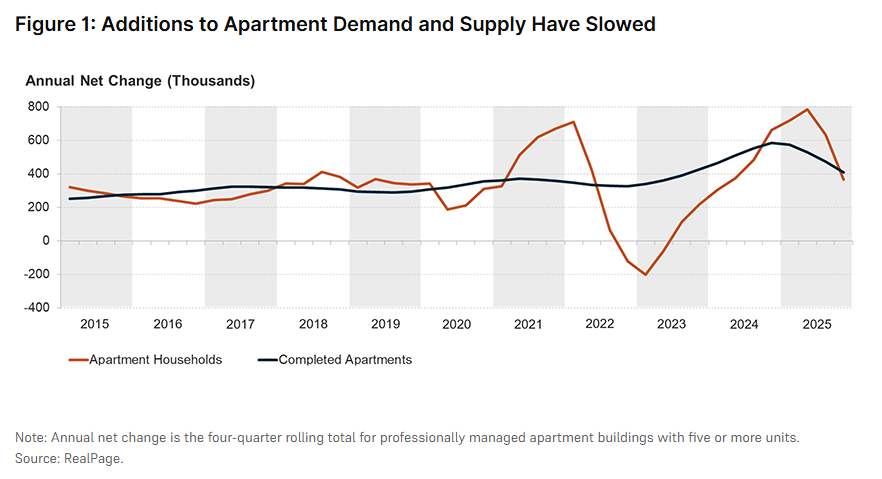
Demand slowdown: Rental demand cooled in late 2025, with new apartment households dropping from 784,000 mid-year to 366,000 by Q4 as the economy softened. At the same time, new supply pushed vacancies higher. Asking rents fell 0.6% YoY in Q4 2025.
K-shaped renters: Industry analyst Jay Parsons says today’s renters split into “haves” and “have-nots.” Higher-income renters spend about 20% of income on rent in Class A/B apartments. Lower-income renters often spend over half their income on housing and rely on older Class C or subsidized units.

Wealthy demand: Harvard data show that the most recent renter growth has come from households earning $75K+, who spend a smaller share of their income on rent. These renters are driving demand for newer, higher-end apartments.
Cooling pipeline: Multifamily construction remains elevated but is cooling. Developers started 416,000 units in 2025, while projects under construction fell from 996,000 in 2023 to 686,000 in 2025. Most new supply targets higher-income renters.
Vanishing affordability: Lower-cost rental supply continues to shrink. From 2014 to 2024, the U.S. lost 9.3M units under $1,400, including 2.5M under $600, while higher-priced units surged.
➥ THE TAKEAWAY
K-shaped market: The U.S. rental market is splitting in two: strong demand for Class A/B apartments from higher-income renters and a growing shortage of affordable housing for lower-income households.
TOGETHER WITH 1031 CROWDFUNDING
Unprecedented Demand for Senior Housing

Senior housing has gained traction with institutional investors as the Baby Boomer generation, the wealthiest generation in U.S. history, ages into higher levels of care. This demographic shift is fueling unprecedented demand for assisted living and memory care communities.
Why invest in Senior Housing?
Senior housing stands out as a sector built on necessity and backed by enduring demographic demand.
10,000 Americans turn 80 every day starting in 2025.
NIC estimates that more than 800,000 additional senior housing units will be needed nationwide by 2030.
At 1031 Crowdfunding, we help investors access senior housing opportunities through tax-advantaged vehicles. We provide exposure to professionally managed portfolios while eliminating the challenges of direct property ownership.
Click to learn more about our featured senior housing investments today.
*Investments offered by Capulent LLC, member FINRA/SIPC. This is a paid advertisement. Please see the full disclosure at the bottom of the newsletter.
✍️ Editor’s Picks
All-in-one investor portal: Save time and reduce complexity by managing the investor lifecycle in one platform — from onboarding with built-in funding and compliance to waterfall calculations, distributions, and reporting. (sponsored)
Spread shrug: Balance-sheet lending spreads for commercial real estate remained largely unchanged despite an oil price shock, suggesting lenders see the disruption as limited or temporary.
Price plateau: U.S. commercial property prices stabilized in Q4 2025, though institutional-quality assets continued to be repriced across sectors.
Built for scale: Henry is redefining CRE marketing by turning Excel models into institutional-grade offering memorandums and BOVs in minutes—dramatically cutting production timelines for high-volume deal teams. (sponsored)
Capital reset: McKinsey says real estate is entering a new cycle marked by slower fundraising, higher interest rates, and a greater focus on operational value.
Credit warning: Private-credit defaults could double as higher rates and refinancing pressure stress borrowers.
🏘️ MULTIFAMILY
Value hit: Rent control proposals in Massachusetts could wipe out $300B in property values, according to a new study.
Credit pivot: Origin is launching a new multifamily credit strategy targeting debt investments backed by hard assets.
Leasing lift: Student housing reached 47.6% pre-leased for fall 2026 by February, rising 1,020 basis points month over month.
Stratus sunset: Stratus Properties is considering liquidation and dissolution following a strategic review.
Bridge capital: BRIDGE Housing raised $92M for a fund focused on acquiring and preserving affordable and workforce housing.
🏭 Industrial
REIT footing: Self-storage REITs are navigating slower rent growth and rising operating costs while adjusting strategies to maintain profitability.
Warehouse rebound: Demand for big-box warehouses is rebounding as logistics tenants return to large distribution footprints.
Tax scrutiny: Virginia lawmakers are reconsidering tax incentives for data centers as the sector’s rapid growth raises policy questions.
🏬 RETAIL
Foot traffic: U.S. mall visits rose in February, with open-air centers up 7.3%, outlets up 7.2%, and indoor malls up 5%.
Mall megadeal: A Redwood West–Panattoni venture acquired the Victoria Gardens lifestyle center for $530M.
Center trade: Brookfield sold the 1.2M-square-foot Victoria Gardens retail center for about $530M with Ares providing financing.
🏢 OFFICE
Absorption record: Manhattan’s office market recorded record absorption in 2025, driven by corporate leasing and a flight to high-quality buildings.
Market shift: San Francisco’s office market is undergoing a major transformation as demand patterns and tenant priorities shift.
Silicon expansion: Data storage company Everpure expanded its Silicon Valley headquarters with a long-term lease through 2040.
🏨 HOSPITALITY
Estate revival: The historic Elm Court Vanderbilt estate in Lenox will be redeveloped into a luxury wellness resort.
Casino bid: Landry’s submitted a $7B acquisition bid for Caesars Entertainment.
Tribeca transaction: The Hilton Garden Inn Tribeca sold for $69M to a French investor.
📈 CHART OF THE DAY
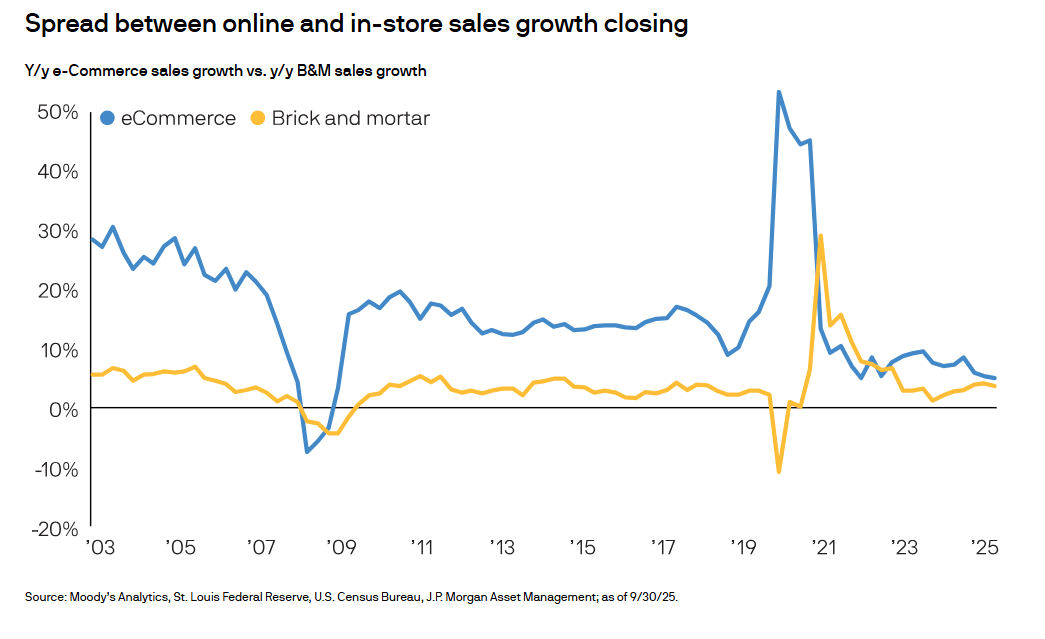
The gap between e-commerce and in-store retail sales growth has steadily narrowed, signaling that online shopping’s pandemic-era surge is fading and brick-and-mortar sales are catching up.
CRE Trivia (Answer)🧠
Denver International Airport is the largest airport in the U.S., spanning more than 33,500 acres—over twice the size of Manhattan.
More from CRE Daily
📬 Newsletters: Stay ahead of the market with local insights from CRE Daily Texas and CRE Daily New York.
🎙️Podcast: No Cap by CRE Daily delivers an unfiltered look at the biggest trends—and the money game behind them.
🗓️ CRE Events Calendar: The largest searchable calendar of commercial real estate events—filter by city or sector.
📊 Market Reports: A centralized hub for brokerage research and market intelligence, all in one place.
📈 Fear & Greed Index: A fully interactive sentiment tracker on the pulse of CRE built in partnership with John Burns Research & Consulting.

You currently have 0 referrals, only 1 away from receiving Multifamily Stress Test Model.
What did you think of today's newsletter? |
Reply